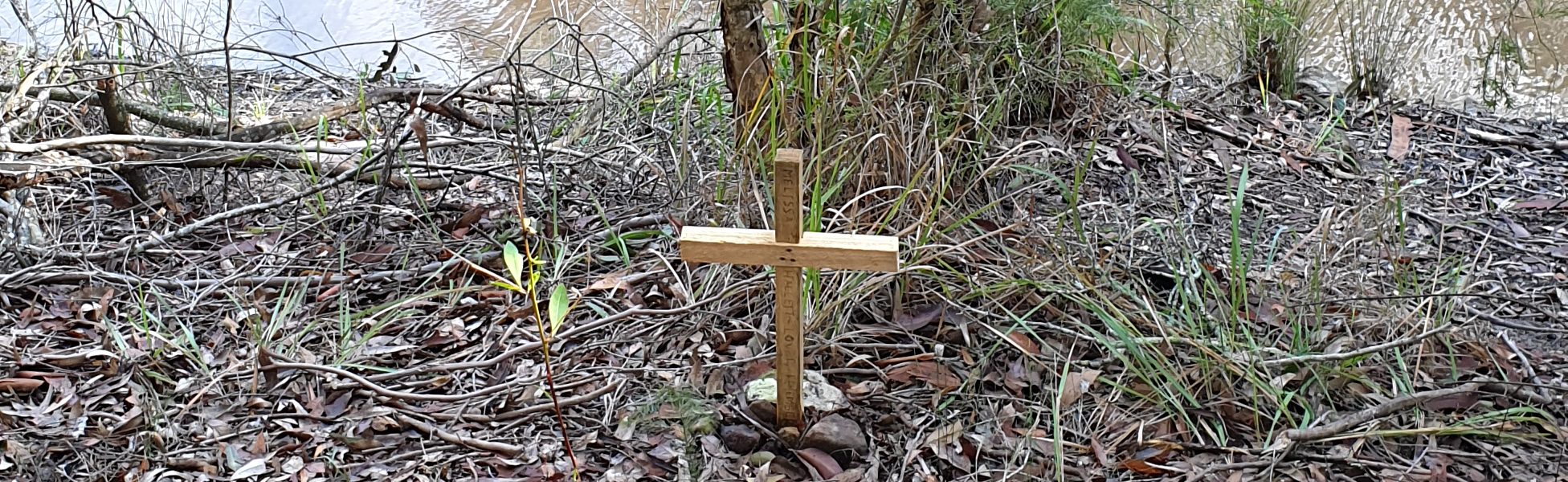

Two couples, one visiting from Sydney, were four-wheel driving in the Stockrington area new Newcastle, on Anzac Day morning 1994.
The terrain was pretty rough. There were old mining rail lines, now rough tracks, and lots of scrubby bush bristling over undulating land.
Stopping at a kind of rough crossroads – an old rail tunnel ahead – the men decided to walk through the bush to a landmark they’d heard of, Burrenjim Dam.

As they made their way through the bush, scurrying down to the water, they headed for the dam wall, about 150 metres long and a metre wide at the top, accessed from a small concrete landing.
The dam was almost full with muddy water and on the other side of the wall, a spillway where water would flow in a gully through the bush.
As they cleared the scrub and stood on the landing one of them quickly saw what you hope never to see. A body floating face down in the water. He called to his friend, they confirmed their worst fears, and returned to their vehicle, the women shocked at the details they shared.
The police were contacted, and very quickly the area was busy with detectives and and other officers and responders, retrieving the body, searching, wondering.
The body was my sister Melissa, but none of her family knew of these happenings. Even when the local news began reporting a body found during that day, we were far away in other towns and cities, unaware.
Except for Melissa’s husband Scott, whom Melissa had left just a week earlier. He had been trying to locate Melissa for some days. He had contacted our father a couple of days earlier to ask if we had any ideas. But it was not unusual, in our experience, for Melissa to lay low for a while – she had a wide network of friends and contacts, much wider than we realised – and so it didn’t seem unusual.
But when Scott heard these reports, he feared the worst and contacted the police. They invited him to identify the body, and he did.
The police rang our father in the evening of Anzac Day 1994 and told him the news. There were not many details and possibly, when he rang his other children in shock, including me, shortly after, even less information was clearly retold.
I’ve shared my experience in receiving that call about 9pm – sitting in our bedroom in our family home in Canberra, my parents in Parkes, my sister in West Wyalong. I felt as if I looked down on myself hearing the words that made no sense.
We’ve learned much more about what happened over the past 30 years but remarkably, none of the big questions have been answered.
Who killed her and why? Where was she killed and with what? How did she get to the dam and who took her there? Where was she in the days immediately before her death? When did she die and what was she thinking and feeling?
Since April 25 1994, millions of people have lost their lives, lost loved ones. We’ve lost other loved ones, also around this time. We’ve lost others to tragedy as well. Most likely you have too. The world has continued to generate life and death, joy and suffering, hope and despair.
But despite 30 years, this death finds a way to linger differently. It must be the unknowing, the violence, the regret, the anger, the threat.

In 2019, after 25 years of unknowing, we refocused efforts to try and break open what feels like a locked room of secrets. Five years later, it remains mostly locked. There’s been extensive media coverage in those five years. A renewed police investigation. A million dollar reward. Mentions in parliament. Many people providing information, some directly, like morsels of hope going sour in the heat.
I don’t know what’s next but still we ask – tell what you know, especially if it answers those questions above. Crimestoppers – 1800 333 000
And my mind is turning to redemption, as it has over the decades, but in a new way I think. Turning to others who are in precarious lives, similar to Melissa’s hidden life that was revealed in the harsh light of media reports that day so long ago. Maybe there’s an answer there, not factual but restorative …
 The unsolved murder of Melissa Hunt